
Roofing in Scottsdale, AZ: Tile, Shingle and Flat Roofs
Call Us
(480) 919-1173
Roof assessments
Findings written down, with photographs
Tile, shingle and flat roofs
Scottsdale and the East Valley
What a 1991 housing stock means for a Scottsdale roof
Scottsdale’s median house was built in 1991, and 43.9% of the city’s homes went up in the 1980s or 1990s. That is the tile era, and tile is where the trouble hides: the covering can look perfect from the driveway while the material under it has stopped shedding water. The tell is a stain that appears at a valley after the first hard monsoon, or a ceiling that darkens in a room with no plumbing above it. By the time a tile roof leaks, the felt has usually been failing for years, and the tiles are the last part of the assembly to show it.
Homes in Scottsdale: the local picture
Median year built 1991, with 43.9% from the 1980s and 1990s
Scottsdale’s 139,168 housing units have a median year built of 1991, and 72.6% of them were standing before 2000. The 1990s supply 23.9% of the stock and the 1980s 20.0%, so 43.9% of the city’s roofs were covered in the two decades when clay and concrete tile became the default here. The city’s own guide to re-roofing says as much: asphalt shingle was used on sloped roofs almost exclusively until the 1990s, and tile took over from there. On those houses the tile is often still sound while the underlayment beneath it is finished, which makes the roof look better than it is. The shingle tail of that stock is smaller but older: 13.6% of the city dates from the 1970s, and those roofs are on their second or third covering by now.
The hail and wind record over Scottsdale, 2016 to 2025
NOAA’s Storm Events file carries 93 records with Scottsdale as the begin location between 2016 and 2025, the densest city record in this part of the valley: 49 thunderstorm wind reports across 26 days, 19 flash flood reports, and 16 hail reports on 8 days, 10 of them at an inch or larger. The largest is 1.75 inches on 26 September 2025 at Scottsdale Municipal, and the strongest wind is 65 knots on 8 August 2018. Reporting density rises with population, so the count measures exposure rather than forecasting the next storm, but it does show a city that gets both: stones that bruise a shingle mat, and wind that lifts what was fastened for a calmer decade. It is also the most recent hail in the file, which matters when a roof is being judged on how it has come through the last two seasons.
72,886 detached houses, most of them owner-occupied
Of Scottsdale’s 139,168 housing units, 72,886 are single-family detached homes. Occupied units total 118,637 and 79,513 of those are owner-occupied, so two households in three own the roof over their head and the decision about it is theirs to make. That matters on a tile roof more than on any other, because the two honest options look nothing alike. One is a repair to a valley or a flashing; the other is lifting the field, replacing the felt and re-laying the tile. The second is a bigger job, and on a house that is staying in the family it is often the one that makes sense, which is why the two options are worth putting side by side in writing before either is booked.
Scottsdale in Maricopa County, 2,339 feet above sea level
Scottsdale sits wholly inside Maricopa County, and the Census place point that anchors this page is 2,339.0 feet above sea level, read through the USGS elevation service. The city runs from the floor of the valley up toward the foothills, so two roofs in the same postcode can sit several hundred feet apart, and the exposed ridge of one takes weather the other never sees. The permit office is the city’s, and any rebate question depends on which utility serves the address, so that is checked rather than assumed before a scope is priced. The city’s One Stop Shop on Indian School Road is where the permit answer comes from, and the guide it publishes is dated, so the current rule is confirmed against the address rather than read off a document older than the code in force.
Roofing services in Scottsdale, AZ
Most of the work in this city falls into one of three buckets: a repair to a detail on a roof with years left, an underlayment or covering replacement on 1980s and 1990s housing, and storm damage that has to be documented before it spreads. The roof decides which, and on tile the deck and the felt usually settle the argument. Age on its own is a poor guide, because a 1994 tile roof that was re-felted in 2012 is in a different place from one still carrying its original underlayment.
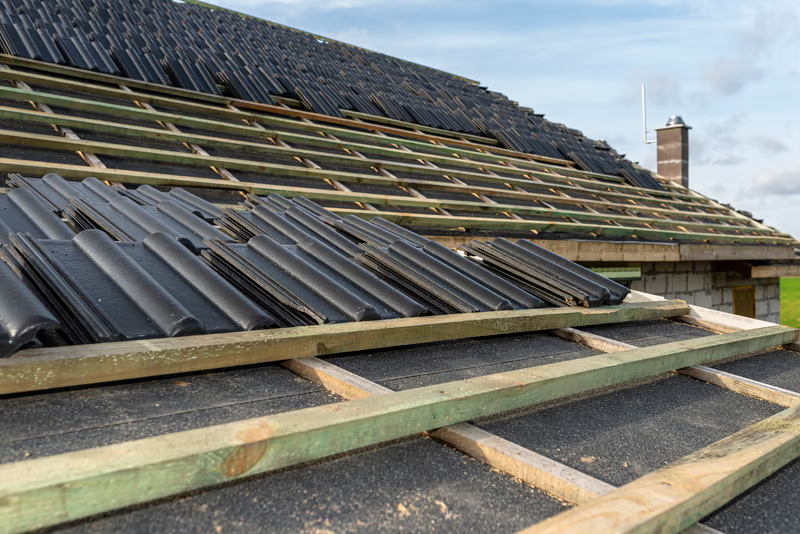
Where the leak is one detail, a valley, a pipe boot, a step flashing against a parapet, roof repair is the right first call. Cracked and slipped field tiles go to tile roof repair, which is a different trade from shingle work and is scoped by the profile being matched rather than by the square. Where the felt has gone and the tile is sound, roof replacement means lifting, re-felting and re-laying, with a breakage allowance written into the scope.
After a hail day, storm and monsoon damage repair starts on the field and the soft metals, because a bruised mat and a dented vent show before a leak does, and the photographs taken that day are what an insurance claim rests on. A roof inspection puts a dated condition record on a house before a sale or a renewal. On the low-slope and foam roofs common on the city’s older commercial and patio areas, a cool-roof coating is a maintenance decision, and the utility rebate for it depends on the roof pitch and on which utility serves the address.
Scottsdale roofs, looked at before the next monsoon
What a roof visit covers on a 1990s Scottsdale house
A visit on an 1980s or 1990s tile roof in this city starts with the water rather than the clock. The attic is opened first, because a stain on a rafter names the slope that is failing while a stain on the ceiling only says that one is. Then the field is walked and the broken tiles counted, the valleys and step flashings are checked by hand, and the underlayment is read at the penetrations, the vents and the wall junctions, which is where it fails first. Tile is brittle underfoot, so the walk itself is done slowly and in the cool of the morning.
Nothing is lifted on that first visit. The output is a written condition note with photographs: which slopes are sound, how much of the field is cracked, whether the felt is at the end of its life or already past it, and whether the scope is a detail or the whole covering. That note is written to be read by someone who was not on the roof, which matters on a sale and on any second opinion. If the tile and the felt both have years left, the note says so and the conversation ends there.
The five findings that decide repair or re-felting
- How much of the tile field is cracked, slipped or re-set with the wrong mortar
- Whether the underlayment is torn at the valleys, the vents and the wall flashings
- Whether the deck is soft where the felt has already failed
- Whether the flashings are metal that has gone or sealant painted over a gap
- Whether the attic vents were sized for the covering that is on the roof now
Where the work stops
- One failed flashing on a sound field is a repair, and it is quoted as one
- A field that is sound over felt that is finished is a re-felt, not a new roof
- The tile is counted and matched by profile before anything is ordered
- The permit question is settled with the city before a start date is given
- The findings are written down, so a second opinion starts from the same facts
Why homeowners in Scottsdale choose this crew
On this city’s tile roofs the difference between a repair and a re-felt is usually a few square feet of felt at a valley, so the visit is built around finding that before an estimate exists. The useful findings on a 1994 house are the state of the underlayment at the penetrations, how many tiles are already broken, and whether the deck has softened where water has been sitting. Those go in writing with photographs, and they are the same findings a buyer, an adjuster or a second roofer would need to hear.
If the field can take another repair, the recommendation is a repair, even though lifting the tile is the larger job. Where the felt is gone, the scope is the slopes it has gone on rather than the whole roof. Because the work stays in one valley, a return visit and a permit question are local errands, and the person who wrote the note answers the phone about it.

Why now, with 1990s tile over felt that is past its life
A house finished in 1994 has had thirty years of sun on the same underlayment, and felt does not fail evenly: it goes first at the penetrations and the valleys, where heat and movement concentrate, and it goes quietly under a field that still looks new. The practical consequence is that a small leak found in June is a flashing, while the same leak found in October, after a monsoon has driven water sideways for a season, is a re-felt over the affected slopes.
Then there is hail. Scottsdale carries 16 hail reports in the ten-year file, 10 of them at an inch or larger, and the largest is 1.75 inches on 26 September 2025 at Scottsdale Municipal. A tile field takes that better than a shingle mat does, but the soft metals do not: vents, valley metal and the caps on the parapets dent, and a dented vent is a gap. On a roof already at the end of its felt, that is the day the two problems meet, and the assessment before it is cheaper than the repair after it.
Scottsdale roofs, street by street
Frequently asked questions about roofing in Scottsdale
Does a re-roof in Scottsdale need a permit?
The city’s published guide to re-roofing a home says a building permit is required if any part of the roof sheathing or structural framing is repaired or replaced, and that the permit may be obtained by the homeowner or a contractor, with the owner ultimately responsible for it being issued. The inspections it lists are sheathing, flashing and felt, and final. The guide is dated, so treat it as the shape of the requirement and confirm the current rule with the city before work starts.
How old are the roofs in Scottsdale?
The median house was built in 1991 and 72.6% of the city’s 139,168 housing units predate 2000, according to the Census Bureau’s 2024 five-year estimate, with 23.9% from the 1990s and 20.0% from the 1980s. Most of those roofs are original tile or a second covering, and on tile the covering usually outlasts the underlayment beneath it, which is why a roof can look sound and still be letting water past the felt.
Is tile better than shingle in this city?
The city’s own guide records the history rather than a verdict: asphalt shingle was used on sloped roofs almost exclusively until the 1990s, and clay or concrete tile became the material of choice from then on. The two fail differently. Shingle loses granule and the mat goes; tile keeps its surface while the felt beneath it ages, and tile is brittle, so a field that is walked carelessly costs more to put right.
How much hail has Scottsdale had?
NOAA carries 16 hail reports with Scottsdale as the begin location between 2016 and 2025, on 8 days, 10 of them at an inch or larger, with a maximum of 1.75 inches on 26 September 2025 at Scottsdale Municipal. Maricopa County as a whole carries 98 hail reports in the same window. On tile the stones matter less to the field than to the soft metals, which dent and then hold water.
Can the tile be kept and the underlayment replaced?
Yes, and on a sound field it is usually the right scope: the tile is lifted and stacked, the old felt is removed, new underlayment goes down and the tile is re-laid, with a breakage allowance agreed before the work starts because some tiles will not survive being lifted. Whether that is the right call depends on how much of the field is already cracked and whether the deck under the felt is still sound.
Next step: get a Scottsdale roof looked at
Call (480) 919-1173 and say what the roof is doing and when the house was built. A 1980s or 1990s tile roof narrows the likely answer before anyone climbs up. The visit ends with the findings in writing: which slopes are sound, how much of the field is cracked, and whether the felt is at the end of its life. Residential Roofing Scottsdale works across the city and the East Valley, and the phone is answered by the people who do the work.